

Shifting Left: A Case Study on Cutting Costs and Accelerating AV Development

Executive Summary

Facing escalating development costs and lengthy validation cycles, a leading Level 4 autonomous vehicle company turned to simulation to complement its real-world driving and modernize its testing strategy. Traditionally reliant mostly on physical testing, the company found that this approach could no longer scale to match the complexity, safety requirements, and speed required for advanced AV programs.

To address these limitations, the team adopted a simulation-led strategy, embedding scenario-based simulation and digital twins across the development workflow, including CI/CD. This didn’t replace real-world testing, but complemented it by enabling earlier, faster, and more controlled validation. This allowed their AV developers and verification & validation (V&V) engineers to identify issues sooner, iterate faster, and reduce dependence on late-stage physical testing.

Using Foretellix’s development toolchain, the company shifted a significant portion of testing from the test track to a virtual environment, enabling continuous, high-coverage validation throughout the software lifecycle. The result:

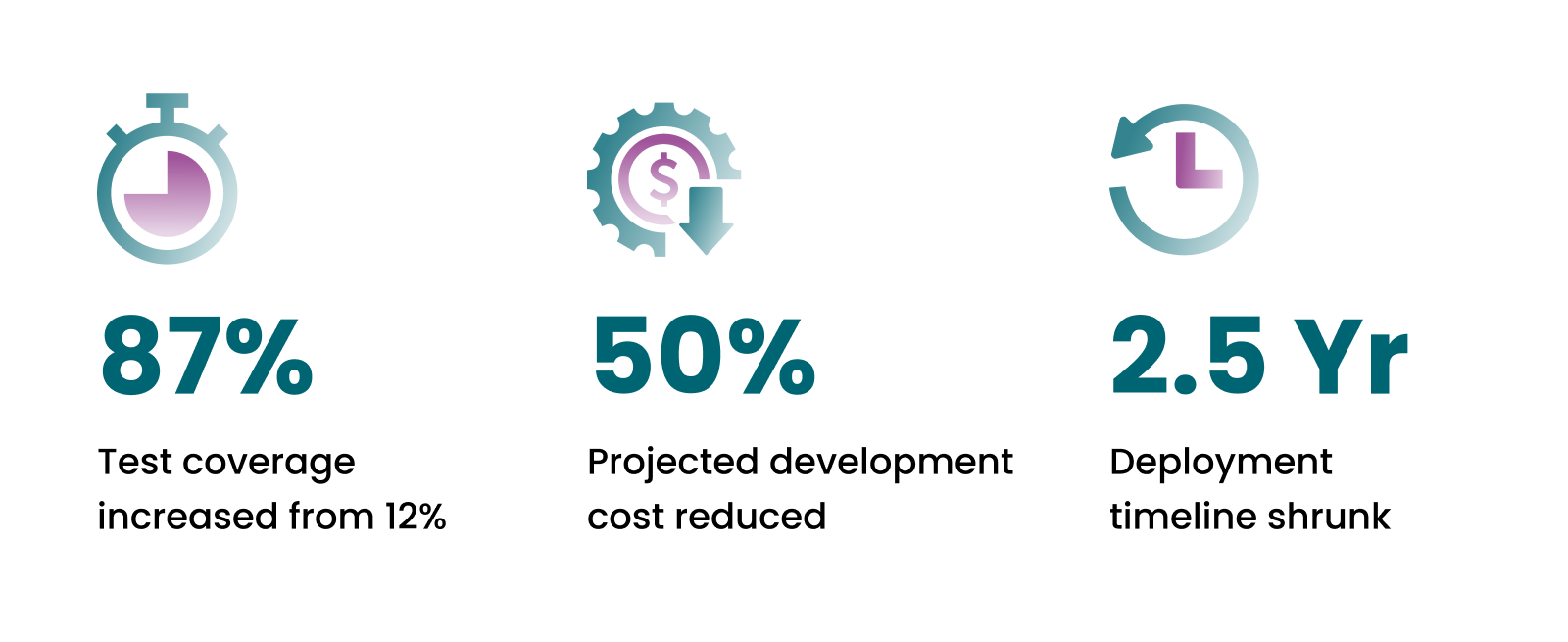
  • Test coverage increased from 12% to 87%
  • Projected development costs were reduced by 50%
  • Deployment timelines shrank from an estimated 4.5 years to less than 2 years
Why Traditional Testing No Longer Scales

As AV programs move toward higher levels of autonomy, physical testing continues to play a critical role, especially in the controlled deployments leading up to removing the safety driver. Most companies will still log tens of thousands or even millions of miles before reaching full driverless operation.

But during development, relying solely on physical testing is increasingly unsustainable. It is expensive, time-consuming, and limited in scope. Reproducing edge cases at scale is nearly impossible, and the long feedback cycles delay issue resolution and slow the entire engineering process. For companies building Level 4 systems, this becomes a significant financial and operational bottleneck.

The cost of inaction is clear: extended timelines, growing validation budgets, and the risk of deploying unverified behavior into safety-critical systems.

This case study explores how one Level 4 AV developer successfully broke that cycle. 

The Challenge

A Level 4 AV development team was facing significant challenges common to many AV development programs. Despite having a highly skilled engineering team and a mature software development process, the organization was constrained by a heavy reliance on physical testing. This resulted in long iteration cycles, limited coverage of real-world edge cases, and rising costs as the system scaled in complexity.

Each new software version required extensive regression testing, but validation could only occur after code had already been integrated and staged for deployment testing. By that point, fixing issues often meant reworking large parts of the system. The developers were left without timely feedback, and the validation engineers struggled to keep pace with the frequency of updates.

Simulation was already part of the dev team’s validation toolkit, but it was isolated from the core development workflow. There was no unified process that allowed the developers to easily test code against high-value scenarios as they built it. Without early visibility into system behavior, bugs accumulated and development slowed.

The need for change became clear. The team needed a way to test earlier, scale validation, and empower both developers and verification engineers to work more effectively. They began exploring how to shift testing left, integrating simulation directly into the software development process and enabling continuous scenario-based validation.

Bringing Simulation into Development Earlier

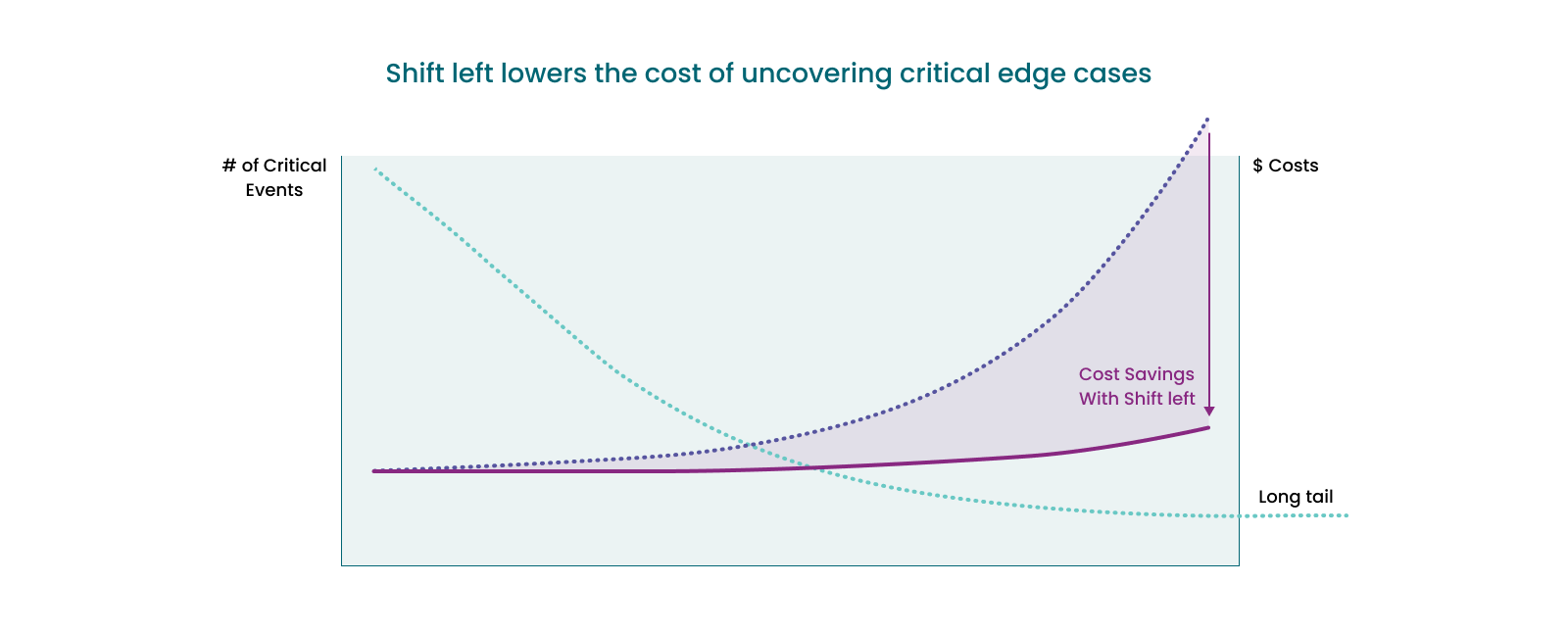
To address these challenges, the company adopted a Shift-Left strategy focused on bringing simulation into the earliest stages of development. Rather than waiting until software had passed through multiple layers of integration, the team integrated scenario-based testing directly into their CI/CD pipeline. This allowed developers to validate changes continuously, using simulation as a fast, repeatable tool for identifying issues before they reached the test track.

Central to this strategy was the use of digital twins. These high-fidelity models recreated vehicle behavior and environmental dynamics in a controlled virtual setting. By embedding the digital twin into the development workflow, the team created a powerful feedback loop where simulation informed design decisions on a daily basis.

Developers and V&V engineers alike benefited from this approach. The developers could run targeted scenario tests as part of their daily workflow, catching regressions or logic errors early. The V&V teams used the same infrastructure to evaluate coverage, prioritize scenarios, and monitor safety-critical performance over time.

Instead of treating simulation as a post-development activity owned solely by validation teams, the company positioned it as a shared asset across development. This organizational change helped reduce costly late-stage failures, improve AV stack quality, and move faster with greater confidence.

Implementation and Methodology

The Shift-Left approach was made possible by a series of deliberate engineering and organizational changes: 

  • At the core was the integration of Foretellix’s scenario-based simulation tools into the development CI/CD infrastructure. Every code change could now trigger a suite of automated virtual tests, enabling the developers to catch issues early and often.
  • Scenario libraries were refined to prioritize relevance and impact. Rather than generating bulk data without clear purpose, the team focused on crafting high-value scenarios tied to real-world performance and historical bug patterns. This targeted approach enabled faster iteration, better resource use, and clearer feedback.
  • To scale testing, the company invested in increased compute resources and built internal capacity to support modeling and test development. Foretellix’s tooling allowed them to run simulations in parallel, reaching the volume and diversity required to uncover edge cases and measure performance with statistical rigor.
  • Toolchain interoperability was another critical element. Custom scripting layers ensured that simulation outputs could be interpreted consistently across teams, and test results flowed back into development dashboards. This closed the loop between testing and design, giving engineers a clear view of how their changes impacted system behavior.

Over time, the team converged on approximately 31 million simulation runs to reach 87% test coverage. By combining continuous feedback, prioritized scenarios, and deep integration into the development pipeline, they were able to validate design decisions earlier, reduce late-stage risk, and create a framework that could scale with program complexity.
Results

The impact of adopting a Shift-Left strategy was both immediate and measurable. By bringing simulation into the development process and enabling continuous, automated testing, the company transformed how it validated its Level 4 autonomous system.

Test coverage increased from 12% to 87% over a six-month period. This dramatic improvement gave the development team greater confidence in the reliability and safety of the system across a wide range of scenarios, including rare and high-risk edge cases that would have been impractical to recreate physically.

Projected development costs were reduced by 50%. This was driven not only by replacing time-consuming physical tests with faster, more scalable virtual ones, but also by dramatically shortening the program timeline. A program that could have taken up to four years was completed in less than two, saving years of additional engineering, validation, and overhead costs.

AV system performance improved across the board. Early testing helped uncover integration issues and unexpected behaviors before they became systemic. As a result, the company shipped a higher-quality AV stack with fewer late-stage surprises and greater system stability.

Together, these results confirm that simulation-led development is both practical and high-impact for organizations looking to scale AV programs safely and efficiently.

Key Learnings and Takeaways

  • Shifting testing earlier in the development lifecycle delivered clear benefits that extended well beyond initial cost and time savings. Rather than replacing physical testing, simulation augmented it, enabling broader test coverage at lower cost, surfacing issues earlier, and reducing dependence on track time for routine validations. This allowed the development teams to focus physical testing on the most safety-critical scenarios, where the highest levels of fidelity were essential.
  • By focusing on high-value scenarios, prioritized based on risk and impact, instead of generating large volumes of low-priority tests, the development team was able to increase test relevance and reduce analysis overhead.
  • Integrating simulation into the CI/CD pipeline empowered developers to take ownership of validation. They no longer had to wait for verification and validation team testing to understand how their code performed. This shift led to faster debugging, tighter feedback loops, and better alignment between software design and real-world behavior.
  • Toolchain interoperability and automated data flows made the testing process repeatable and scalable. Results were consistent across builds, and insights were easier to act on. Verification became part of the development rhythm rather than a separate step.

This case demonstrates what is possible when AV developers adopt a simulation-first strategy where simulation is embedded throughout the workflow, starting early and used continuously alongside physical testing. By shifting testing earlier, integrating simulation into CI/CD, and prioritizing scenario relevance, the company moved from a reactive validation model to a proactive, scalable development process.

Simulation is not just about efficiency. It is about building safer, more reliable systems with fewer resources and greater confidence. As more companies look to scale Level 4 autonomy, the ability to validate early and often will become a baseline requirement.

Foretellix is helping teams make that transition. If you are working on an AV stack for high levels of autonomy and want to explore how simulation can be integrated into your development process and can accelerate your progress, we invite you to get in touch.

Sign up for a demo to see how Foretellix enables AV developers to move faster, test smarter, and build with confidence.


Additional content for you

Automated Scenario Curation for Safer ADS

This is the second blog in a series. In the first blog (Accelerating Automated Driving System Deployment with Scalable, Data-Driven Evaluation), Mike Stellfox pointed out that the real challenge in AV development has shifted from simply building systems to ensuring we can truly trust them....

Interview with Glen De Vos - Foretellix’s Newest Board Member

You’re joining our board as Temasek’s representative, what about our technology, team, and vision excites you? What excites me about working with the Foretellix team is that they are offering a comprehensive solution to a critical issue that OEM’s and Tier 1’s are facing during the development of Level 2++, 3 and 4 advanced mobility systems. ...

Why High-Fidelity Sensor Simulation Is Critical for AV Development and Testing

Autonomous vehicles (AVs) must safely navigate complex and unpredictable environments. Yet even the most advanced perception systems face limitations when an object or road user is temporarily hidden from view. These occlusion scenarios, blind spots caused by obstructing vehicles, are among the most critical and difficult to test....

Register to receive ALKS scenarios verification code examples

AI, Autonomy, V&V and Abstractions – Automating at Hyper Speed

Subscribe to our newsletter

Ziv Binyamini

CEO & Co-Founder

Ziv is a verification visionary and a passionate leader. Previously, Ziv served as Corporate VP at Cadence running the simulation and verification business. Through his career at Cadence, Verisity and Intel, Ziv led the development of verification businesses including chip simulation and Verification IP, industry first Coverage Driven Verification solutions and test bench products including Specman for chip verification and Perspec for SoC HW/SW verification.

Yoav Hollander

CTO & Founder

Yoav is a world expert and leader in complex systems expert verification and validation. he Invented the “e” verification language and related methodology (later followed by the UVM methodology). Yoav founded Verisity to deliver “e” and related tools. Verisity was acquired by Cadence Design Systems. In the last few years, Yoav has been researching complex-system verification.

Gil Amid

Chief Regulatory Affairs Officer, VP Operations & Co-founder

Gil is a former Vice President of Intel Corp. Gil has 30 years of experience working for Intel , in which he led the development of EDA and CAD tools in all design domains as well as leading VLSI design projects. In his recent years he was in charge of (among others) the verification tools development organization within Intel.

Jeni Osternik

Jeni Osternik

VP Product & Execution

Jeni is a versatile leader with over 17 years of experience spanning product management, operations, engineering, and business leadership. He leads the company’s product and delivery execution, ensuring the successful alignment of business, technology, and customer value. Before joining Foretellix, Jeni held management roles in the defense and homeland security sectors, where he led multidisciplinary teams and large-scale international programs, driving growth and innovation across complex technology ecosystems.

Vicky Revzin

HR & Global Employee Operations Director

Vicky Revzin – HR & Global Employee Operations Director

Ron Grossberg

VP R&D

Ron is an experienced manager and a passionate software engineer with more than 20 years of experience. Previously Ron managed a group in Algotec (now a Philips subsidiary), fully in charge of the development of complex medical imaging software used by radiologists in thousands of hospitals around the globe. Ron started his way in the IDF programming academy and technological units.

Roger Ordman

VP Marketing

Roger has over 20 years of global experience managing product, marketing and business development teams. Roger’s experience spans the networking, mobile and automotive industries previously serving as EVP of Marketing at Aurora Labs, and Marketing and Product Director at HARMAN. Roger is a frequent speaker on emerging trends in automotive software and holds an engineering degree in Industrial Management from Tel Aviv University.

Udi Jacobi

Udi Jacobi

Chief Commercial Officer

Udi has over 20 years of commercial leadership experience, managing and growing businesses throughout the USA, Europe, and APAC. His experience spans a broad range of industries and disciplines, including Automotive, New Media, and Digital Transformation. Prior to joining Foretellix, Udi founded and successfully grew Brightcom Media into a multi-million-dollar profitable business.

Doron Ilan

CFO

Doron is an experienced CFO with over 20 years in corporate finance, in various private and public companies. As the CFO of 012 Smile Telecom [Nasdaq: BCOM], he led the company’s successful NASDAQ IPO, and later, as the CFO of SuperCom [SPCB] executed an M&A process and a public offering on NASDAQ. In recent years he was the CFO of Xfone, an Israeli telecom provider.

Sharon Rosenberg

Solution Architect & Chief Methodologist

Sharon has over two decades of experience in the verification and validation of highly complex systems. He is the author of two landmark verification & validation textbooks and a key contributor to ASAM OpenSCENARIO® 2.0.

Mike Stellfox

Head of Methodology

Mike is a world expert in advanced verification methodologies and solutions. He has spent more than twenty-five years working with customers around the world on solutions to address their verification challenges in a wide range of industries from Automotive and Autonomous Transport, to Mobile and Hyperscale Computing, to Aerospace and Defense. Before joining Foretellix, Mike was a Fellow at Cadence where he helped transform the semiconductor industry’s approach to verification, based on the automated verification solutions he helped pioneer at Verisity in the early 2000s. Mike started his career at IBM as a VLSI Chip Designer.

Alex Hitzinger

CEO & Co-Founder

Alex started his automotive career at Toyota Motorsport before joining Cosworth and Red Bull Technology. Hitzinger then joined Porsche as Technical Director and Chief Engineer of Porsche 919, which won the 24 Hours of Le Mans in 2015. He spent three years at Apple as Head of Product Design for Project Titan. Most recently, Hitzinger served as Senior Vice President of Autonomous Driving at VW Group and Member of the Executive Board VWN, where he was involved in developing the ID Buzz. He also served as Chief Executive Officer of Artemis GmbH, where he was the Chief Architect of the revolutionary new vehicle concept for next-generation autonomous mobility for their flagship-product Audi Landjet.

Moshe Gavrielov

Chairman of the Board

Moshe Gavrielov last served as the President and CEO of Xilinx from 2008-2018, during which the company delivered three successive generations of technology leadership. These yielded revenue growth to over $2.5B, significantly increased profitability, and market share expansion. As a result market capitalization quadrupled during his tenure and approached $20B. Prior to that Moshe was the CEO of Verisity, delivered revenue growth to over $70M while leading its successful IPO in 2001 and led its sale to Cadence for $315M in 2005. Prior to Verisity, Moshe served in numerous executive management roles in LSI Logic, Digital Equipment and National Semiconductor.

Boaz Schwartz

Chairman of the Board

Boaz Schwartz is a seasoned finance professional and a tech investor. Dr. Schwartz has founded and managed Deutsche Bank Israel for 24 years and until December 2020. Following his retirement from Deutsche Bank, Boaz has become an active tech investor in both early and late-stage companies. Dr. Schwartz is a board member of IDC Herzliya, iArgento Ltd and the vice-Chairman of Zabar Solar Ltd. He earned a Ph.D in Finance from the University of Chicago; MBA with Distinction from the Wharton School at the University of Pennsylvania; MSc and BSc in Electrical Engineering from the University of Tel Aviv.

Gil Goren

CEO & Co-Founder

Gil Goren joined 83North in 2016, after more than a decade at EMC in a variety of roles in Boston and Tel Aviv. At his last role as SVP & Managing Partner at EMC Ventures he managed strategic partnerships Investments and M&A internationally. Prior investments include Anobit (acquired by Apple), XtremIO & ScaleIO (both acquired by EMC), Cyvera & Secdo (both acquired by Palo Alto Networks), Adallom (acquired by Microsoft), CloudEndure (acquired by Amazon) Jfrog, RedisLabs, Guardicore and VastData among others. Currently on the boards of VDOO, Foretellix, and IBEX. He has B.SC in Electrical Engineering from the Technion and MBA from Boston University.

Glen De Vos

Mr. De Vos has over 30 years of senior leadership experience in automotive and industrial technology sectors, particularly around autonomy and mobility. In his career he has held a number of leadership roles at Aptiv and its predecessor Delphi Automotive. Positions included Chief Technology Officer and President of the Advanced Safety and User Experience business unit. He currently serves as the CEO of MicroVision, Inc.

Mark Mohr

VP Global Sales & Business Development

Since March 2021 Mark is SVP of Vehicle Technology at Volvo Group Truck Technology. Before he was Head of Development Commercial Vehicle Division at ZF Friedrichshafen AG. In this role, Mark’s main was on driver assistance systems automation, new hardware, and software architectures besides the classical driveline and chassis business. Since his Ph.D. in Mechanical Engineering from the Technical University Kaiserslautern, Germany, he has a long experience in simulation and digital engineering.

Carl-Peter Forster

VP Global Sales & Business Development

Carl-Peter Forster started his career at McKinsey & Company as a management consultant in 1982. After four years there, he joined BMW in Munich, where he became a member of the Executive Board in 1999 as head of global manufacturing. In 2001, he joined the European division of General Motors and became Managing Director of Opel and Vice President of GM Europe. In 2006 he became CEO and President of GM Europe and joined the parent company’s Global Automotive Strategy Board. After leaving General Motors, he became Group CEO at Tata Motors, where he was responsible for the Jaguar and Land Rover brands. In 2013, he joined the boards of Geely Automotive Holdings and Volvo Cars.

Eran Sandhaus

Eran recently led Delphi Automotive’s (now Aptiv) Autonomous Driving and Connected Services business unit, overseeing global engineering teams, business staff and wholly owned subsidiaries focused on providing hardware, software, algorithms and cloud services to transform future mobility. Prior to Delphi, Eran was a senior executive for over 20 years in Fortune 500 companies including Qualcomm, Cypress, Texas Instruments and Marvell. During this period Eran led global businesses, operations and M&A focused on server communications, storage, mobile handsets and Internet-of-Things (IoT) for consumer, automotive and industrial applications.

Benny Schnaider

Benny Schnaider is a high-tech serial entrepreneur. Benny co-founded Ravello Systems and served as its President and Chairman. The company has developed an over-the-top cloud services. Since Ravello acquisition by Oracle in 2016, Benny serves as VP SW development for Oracle-Ravello. Previously, Benny co-founded and was the CEO Qumranet (KVM), acquired by Red Hat in 2008. Co-founded P-Cube, acquired by Cisco in 2004. Benny was the CEO and Founder of PentaCom Ltd., acquired by Cisco in 2000. Benny invests and serves as a board member in several startups like: Traffix Systems (acquired by F5 in 2012) and B-Hive (acquired by VMware in 2008), ScyllaDB, Otonomo, Colabo, CathWorks.

Book A Meeting