


NVIDIA has released Alpamayo 2 Super, an E2E Physical AI foundation model for advanced autonomous development. This open reasoning Vision-Language-Action (VLA) model is available for modification, redistribution and commercial use under the OpenMDW 1.1 license.
Alpamayo 2 Super is NVIDIA’s most powerful open driving foundation model to date. The 34-billion-parameter model combines perception, reasoning, planning and action across multiple autonomous driving tasks.
Alpamayo 2 Super’s technical capabilities and broad commercial accessibility make this release a significant contribution to the autonomous vehicle industry.
Openly available AI driving models create an even greater validation challenge
As foundation models become more capable and widely available, validating them becomes exponentially more difficult.
The challenge is no longer only developing an intelligent driving model but also fine-tuning, integrating, and validating the AV stack. Validation is required to demonstrate, with measurable evidence, that the AV stack behaves safely across the Operational Design Domain (ODD), including the rare, complex, and safety-critical situations that matter most.
Developers need to answer questions such as:
- Which driving situations has the model actually been evaluated against?
- Where do coverage gaps still exist in the ODD?
- How does the model behave when critical scenario parameters are systematically varied?
- Which scenarios expose weaknesses in reasoning or planning?
- What evidence is required to demonstrate that the system is ready for deployment?
Answering these questions requires a scalable, independent, measurable evaluation methodology that combines real-world data, simulation, scenario variation, and coverage analysis into a continuous validation workflow.
Validation is becoming a competitive, and regulatory, requirement
As autonomous driving programs accelerate, independent validation is becoming a key differentiator rather than a final verification step.
Development teams must continuously evaluate new model versions, compare performance across releases, identify regressions, and generate objective evidence that safety is improving over time.
At the same time, regulatory expectations continue to evolve.
UNECE WP.29 R185, which takes effect in January 2027, requires manufacturers to demonstrate coverage of the Operational Design Domain as part of their safety case, supported by documented methodologies, measurable targets, and evidence gathered across virtual, track, and real-world testing.
For foundation-model-based autonomous driving systems, scalable validation is becoming as important as model development itself.
Foretellix provides the validation layer for AI-powered autonomous driving
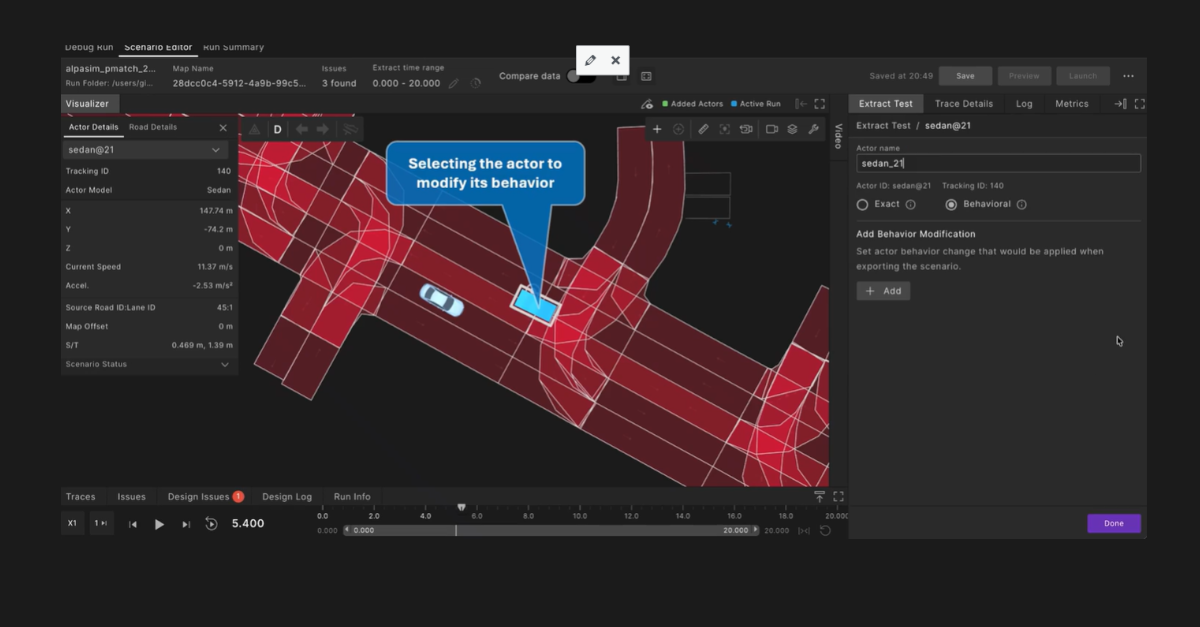
Foretellix is working with the NVIDIA Alpamayo ecosystem through a reference solution that combines the Foretellix platform with NVIDIA technologies to enable scalable AI-powered AV development and validation.
The solution transforms driving data into measurable evaluation workflows by:
- Curating meaningful driving scenarios from large-scale driving data.
- Generating controlled scenario variations to systematically evaluate model behavior.
- Measuring scenario and ODD coverage to identify critical safety gaps.
- Tracking evaluation results across successive model iterations.
- Producing objective evidence to support deployment decisions and regulatory compliance.
The reference solution also integrates NVIDIA Omniverse NuRec, Cosmos, and AlpaSim, enabling real-world drive logs to be reconstructed as simulation-ready environments that can be systematically varied to evaluate AI driving systems under controlled conditions.
Rather than simply asking whether a model performs well, development teams can continuously understand where it performs well, where it does not, and what additional evidence is needed before deployment.
Learn more about the Foretellix NVIDIA Alpamayo Reference Solution.
Building the next generation of autonomous driving
Foundation models such as NVIDIA Alpamayo 2 Super represent a major step forward in autonomous driving AI.
As these models become the engine of autonomous vehicles, scalable validation becomes the foundation for safe deployment.
Together, NVIDIA’s AI foundation models and Foretellix’s independent validation platform enable development teams to build, measure, validate, and continuously improve AI-powered driving systems with objective, scalable evidence across real-world data, reconstructed environments, and simulation.
Learn more about how Foretellix is enabling NVIDIA developers to design, test, and safely deploy AI-powered vehicles with greater confidence and scale.
The future of autonomous driving will not be defined only by how intelligent AI models become, but by how confidently we can prove they are ready for the road.