Beyond NCAP: Achieving ADAS Safety in the Real World

Short on time? Below is a podcast summary of this blog, generated by Google NotebookLM.

Many of today’s most advanced vehicles proudly display their 5-star NCAP safety ratings, and for good reason. These standardized tests have driven major safety improvements across the industry, offering a reliable benchmark for features like Advanced Emergency Braking (AEB) and Crash Avoidance.

But passing NCAP doesn’t always mean a system is ready for the real world. Slight deviations in pedestrian appearance, road layout, or vehicle speed can cause even 5-star-rated systems to miss, delay, or fail to respond.

This discrepancy highlights a growing need: ensuring that ADAS functions perform not just in controlled conditions, but across the variability and unpredictability of actual roads. Bridging that gap requires rethinking how we define, execute, and scale scenario testing.

The Limits of NCAP’s Concrete Scenarios

NCAP (New Car Assessment Program) protocols are designed to evaluate how well a vehicle performs in a tightly defined set of safety-critical scenarios. These tests are extremely specific: fixed layouts, precise vehicle speeds (e.g., 10, 15, or 20 kph), limited target types (adult pedestrian, bicycle, motorcycle), and predetermined trajectories. While this standardization supports repeatability and scoring, it does not reflect the variability of the real world.
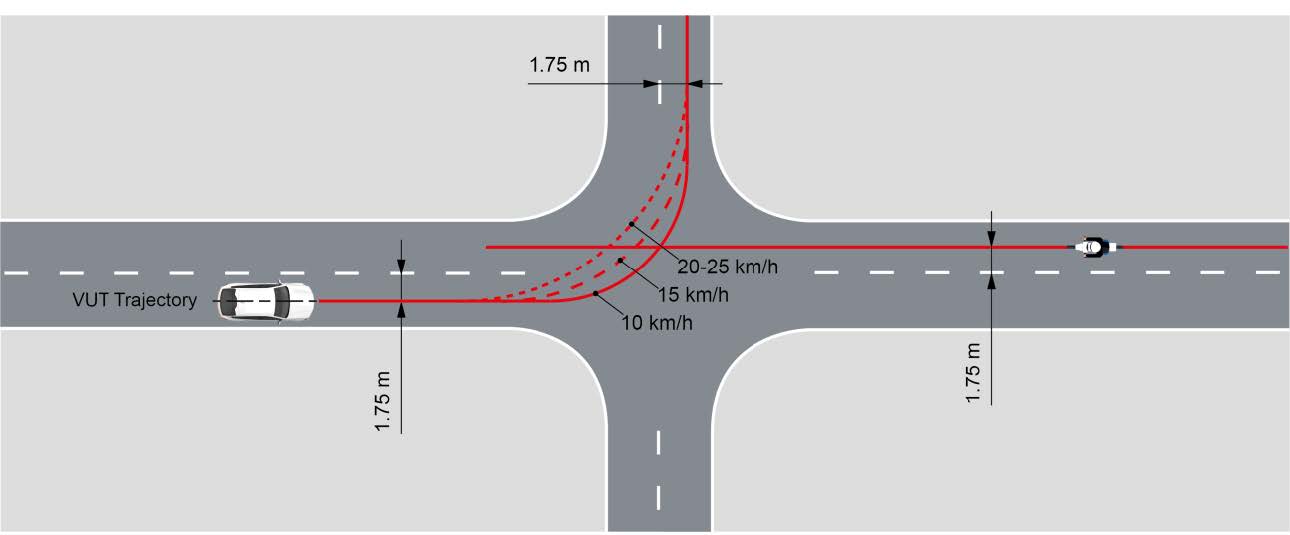
CMFtap scenario VUT and EMT paths

As noted in ISO 34505, “From a mathematical perspective the probability of a concrete scenario (concrete values of continuous parameters) is zero”, in other words: the probability that any one NCAP scenario will occur exactly as defined is essentially zero. Junction angles vary. Pedestrians don’t always walk straight. Vehicles arrive at different speeds and lateral positions. Even a small deviation can trigger a different outcome, including total system failure.

We’ve seen this in practice in the tests performed by Luminar Technologies at the CES conference in Las Vegas in 2022 and 2023.  A range of 5-star Euro NCAP vehicles, including models from Tesla, BMW, Audi, Mercedes, and Lexus, were tested in scenarios that deviated slightly from the NCAP spec. Sometimes the pedestrian was a child instead of an adult, or crossed at a slight angle instead of straight on. In many of these cases, the vehicle didn’t brake at all or braked too late to prevent a serious impact.

And yet, most OEMs still optimize their ADAS systems to pass these tests alone. The risk here is overfitting: vehicles perform well in NCAP but fail in near-identical situations not explicitly covered by the protocol.

Foretellix Helps Teams Go Further with Abstract Scenarios

To achieve real-world ADAS safety, not just compliance, developers need to go beyond NCAP’s constrained test space. Foretellix’s scenario-based approach enables teams to do both: execute official NCAP test cases and collect KPIs and coverage metrics during those runs, and go further with large-scale, abstract testing to capture real-world variability.

For example, rather than testing a left-turn-across-path (LTAP) scenario at just three ego speeds and three oncoming speeds (as NCAP prescribes), Foretellix can generate and execute hundreds of tests across randomized speeds, angles, actor types, and arrival timings without needing to manually script each case. If a system performs consistently across this abstract scenario space, teams gain confidence not just in its ability to pass NCAP, but to handle reality.

This approach also ensures that developers don’t fall into the trap of false positives or missed edge cases that may appear only in low-frequency conditions.

Example: Lane Support System With Oncoming Vehicle

Here’s what that looks like in practice, using a Lane Support System (LSS) scenario with an oncoming vehicle:

NCAP defines very specific parameters for an Emergency Lane Keeping oncoming vehicle scenario:

  • Road curvature: 0 (straight)
  • Global Vehicle Target (GVT or aka oncoming vehicle) lane offset: 1.5 m
  • Collision overlap: 10% of the ego vehicle’s front bumper
  • Swerve side: Left (driver’s side)
  • Lateral speed values tested: 0.2, 0.3, 0.4, 0.5, 0.6 m/s

These fixed parameters are used to verify Lane Support System (LSS) response under very specific conditions. But real roads aren’t that predictable.

Foretellix abstract testing lets you define parameters that are both broader and more realistic. The list below shows one example set that would be valuable to test:

  • Vehicle Under Test (VUT) speed is varied across [50–130] kph
  • GVT oncoming vehicle with speed across [50–130] kph
  • GVT offset ranges from 0 to 3 meters
  • Swerve timing ranges from 5 to 20 seconds before potential impact
  • Swerve amplitude ranges from 1 to 1.5 meters
  • Simulations are run across a wide range of road curvatures and map geometries

This kind of coverage-driven, insight-rich workflow helps teams catch issues early, improve performance robustness, and make data-backed safety claims with confidence, enabling:

  • Running hundreds of automatically generated abstract scenarios
  • Automatically filtering runs based on outcomes, e.g., largest lane-border exceedance
  • Analyzing aggregated metrics like:
    • Lateral acceleration
    • Minimum distance to target
    • Lateral deviation at key timepoints
  • Quickly identifying fragile behaviors or regressions that wouldn’t show up in standard NCAP testing

One Platform, Multiple Validation Modes

Foretellix’s toolchain supports validation across the full range of test types: abstract, concrete, and real-world.

Foretify Evaluate helps teams measure where they are in the development and testing process. It enables coverage analysis, triage, and KPI tracking across both abstract and concrete scenarios. Whether a test comes from a synthetic input, a real-world log, or a concrete NCAP replay, Foretify Evaluate applies the same metrics and analysis, helping teams understand what has been tested and what gaps remain.

Smart Replay, part of Foretify Generate, lets teams recreate exact NCAP tests or run slight variations on them. For example, teams can simulate the same concrete test with a vehicle 10 cm off the centerline or approaching 2 kph faster, conditions that might easily occur in reality but fall outside the rigid NCAP specs. This helps identify fragile behavior early and improves performance robustness.

In parallel, Foretellix’s abstract scenario technology can be used to automatically generate thousands of concrete test instances, systematically covering parameter ranges around the original NCAP setup. This makes it possible to validate both compliance and robustness using the same infrastructure.

Together, these tools allow OEMs and Tier 1s to layer abstract testing around concrete scenarios, improving their safety case without sacrificing compliance. And that approach isn’t just effective; it’s aligned with where regulation is heading.

Aligned with Where Regulation Is Heading

Euro NCAP 2026 marks a shift toward broader safety validation. The new protocols introduce a Robustness Layer that allows small variations in test parameters, such as slight speed or offset changes, and formally support simulation to validate these deviations when physical testing isn’t feasible.

Other standards, including UN DCAS proposals, are following suit. Regulators increasingly recognize that real-world safety depends on more than rigid track tests, requiring scalable, explainable, scenario-based validation.

Foretellix enables teams to meet today’s requirements while preparing for tomorrow’s expectations, providing the flexibility and coverage regulators are beginning to call for.

From Checkbox Compliance to Real-World Confidence

Today, many OEMs test for compliance and hope for generalization. But “hope” isn’t a safety strategy. As simulation credibility improves and regulatory expectations shift, the industry is moving toward coverage-based verification at scale.

Foretellix empowers this transition by giving ADAS teams the ability to validate broadly, measure meaningfully, and act confidently without duplicating effort or sacrificing transparency. This approach blends well with concrete NCAP tests on test tracks and testing in simulation using concrete and abstract scenarios.  This hybrid approach lowers cost and speeds up the process of achieving NCAP compliance in the quest to improve real world safety.

Whether you’re preparing for NCAP, scaling real-world validation, or doing both in parallel, Foretellix helps you get there with a smarter, more scalable testing workflow. Contact us today to learn more.

About the Author

Sebastian Klaas – Director of Product Management at Foretellix, drives the strategic development of the Foretify platform. Prior to Foretellix, Sebastian held senior technical positions in Audi, Luminar, and Samsung Semiconductor. He holds a degree in Computer Science from the Karlsruhe Institute of Technology (KIT).

 

Additional content for you

Automated Scenario Curation for Safer ADS

This is the second blog in a series. In the first blog (Accelerating Automated Driving System Deployment with Scalable, Data-Driven Evaluation), Mike Stellfox pointed out that the real challenge in AV development has shifted from simply building systems to ensuring we can truly trust them....

Interview with Glen De Vos - Foretellix’s Newest Board Member

You’re joining our board as Temasek’s representative, what about our technology, team, and vision excites you? What excites me about working with the Foretellix team is that they are offering a comprehensive solution to a critical issue that OEM’s and Tier 1’s are facing during the development of Level 2++, 3 and 4 advanced mobility systems. ...

Why High-Fidelity Sensor Simulation Is Critical for AV Development and Testing

Autonomous vehicles (AVs) must safely navigate complex and unpredictable environments. Yet even the most advanced perception systems face limitations when an object or road user is temporarily hidden from view. These occlusion scenarios, blind spots caused by obstructing vehicles, are among the most critical and difficult to test....

Register to receive ALKS scenarios verification code examples

AI, Autonomy, V&V and Abstractions – Automating at Hyper Speed

Subscribe to our newsletter

Ziv Binyamini

CEO & Co-Founder

Ziv is a verification visionary and a passionate leader. Previously, Ziv served as Corporate VP at Cadence running the simulation and verification business. Through his career at Cadence, Verisity and Intel, Ziv led the development of verification businesses including chip simulation and Verification IP, industry first Coverage Driven Verification solutions and test bench products including Specman for chip verification and Perspec for SoC HW/SW verification.

Yoav Hollander

CTO & Founder

Yoav is a world expert and leader in complex systems expert verification and validation. he Invented the “e” verification language and related methodology (later followed by the UVM methodology). Yoav founded Verisity to deliver “e” and related tools. Verisity was acquired by Cadence Design Systems. In the last few years, Yoav has been researching complex-system verification.

Gil Amid

Chief Regulatory Affairs Officer, VP Operations & Co-founder

Gil is a former Vice President of Intel Corp. Gil has 30 years of experience working for Intel , in which he led the development of EDA and CAD tools in all design domains as well as leading VLSI design projects. In his recent years he was in charge of (among others) the verification tools development organization within Intel.

Jeni Osternik

Jeni Osternik

VP Product & Execution

Jeni is a versatile leader with over 17 years of experience spanning product management, operations, engineering, and business leadership. He leads the company’s product and delivery execution, ensuring the successful alignment of business, technology, and customer value. Before joining Foretellix, Jeni held management roles in the defense and homeland security sectors, where he led multidisciplinary teams and large-scale international programs, driving growth and innovation across complex technology ecosystems.

Vicky Revzin

HR & Global Employee Operations Director

Vicky Revzin – HR & Global Employee Operations Director

Ron Grossberg

VP R&D

Ron is an experienced manager and a passionate software engineer with more than 20 years of experience. Previously Ron managed a group in Algotec (now a Philips subsidiary), fully in charge of the development of complex medical imaging software used by radiologists in thousands of hospitals around the globe. Ron started his way in the IDF programming academy and technological units.

Roger Ordman

VP Marketing

Roger has over 20 years of global experience managing product, marketing and business development teams. Roger’s experience spans the networking, mobile and automotive industries previously serving as EVP of Marketing at Aurora Labs, and Marketing and Product Director at HARMAN. Roger is a frequent speaker on emerging trends in automotive software and holds an engineering degree in Industrial Management from Tel Aviv University.

Udi Jacobi

Udi Jacobi

Chief Commercial Officer

Udi has over 20 years of commercial leadership experience, managing and growing businesses throughout the USA, Europe, and APAC. His experience spans a broad range of industries and disciplines, including Automotive, New Media, and Digital Transformation. Prior to joining Foretellix, Udi founded and successfully grew Brightcom Media into a multi-million-dollar profitable business.

Doron Ilan

CFO

Doron is an experienced CFO with over 20 years in corporate finance, in various private and public companies. As the CFO of 012 Smile Telecom [Nasdaq: BCOM], he led the company’s successful NASDAQ IPO, and later, as the CFO of SuperCom [SPCB] executed an M&A process and a public offering on NASDAQ. In recent years he was the CFO of Xfone, an Israeli telecom provider.

Sharon Rosenberg

Solution Architect & Chief Methodologist

Sharon has over two decades of experience in the verification and validation of highly complex systems. He is the author of two landmark verification & validation textbooks and a key contributor to ASAM OpenSCENARIO® 2.0.

Mike Stellfox

Head of Methodology

Mike is a world expert in advanced verification methodologies and solutions. He has spent more than twenty-five years working with customers around the world on solutions to address their verification challenges in a wide range of industries from Automotive and Autonomous Transport, to Mobile and Hyperscale Computing, to Aerospace and Defense. Before joining Foretellix, Mike was a Fellow at Cadence where he helped transform the semiconductor industry’s approach to verification, based on the automated verification solutions he helped pioneer at Verisity in the early 2000s. Mike started his career at IBM as a VLSI Chip Designer.

Alex Hitzinger

CEO & Co-Founder

Alex started his automotive career at Toyota Motorsport before joining Cosworth and Red Bull Technology. Hitzinger then joined Porsche as Technical Director and Chief Engineer of Porsche 919, which won the 24 Hours of Le Mans in 2015. He spent three years at Apple as Head of Product Design for Project Titan. Most recently, Hitzinger served as Senior Vice President of Autonomous Driving at VW Group and Member of the Executive Board VWN, where he was involved in developing the ID Buzz. He also served as Chief Executive Officer of Artemis GmbH, where he was the Chief Architect of the revolutionary new vehicle concept for next-generation autonomous mobility for their flagship-product Audi Landjet.

Moshe Gavrielov

Chairman of the Board

Moshe Gavrielov last served as the President and CEO of Xilinx from 2008-2018, during which the company delivered three successive generations of technology leadership. These yielded revenue growth to over $2.5B, significantly increased profitability, and market share expansion. As a result market capitalization quadrupled during his tenure and approached $20B. Prior to that Moshe was the CEO of Verisity, delivered revenue growth to over $70M while leading its successful IPO in 2001 and led its sale to Cadence for $315M in 2005. Prior to Verisity, Moshe served in numerous executive management roles in LSI Logic, Digital Equipment and National Semiconductor.

Boaz Schwartz

Chairman of the Board

Boaz Schwartz is a seasoned finance professional and a tech investor. Dr. Schwartz has founded and managed Deutsche Bank Israel for 24 years and until December 2020. Following his retirement from Deutsche Bank, Boaz has become an active tech investor in both early and late-stage companies. Dr. Schwartz is a board member of IDC Herzliya, iArgento Ltd and the vice-Chairman of Zabar Solar Ltd. He earned a Ph.D in Finance from the University of Chicago; MBA with Distinction from the Wharton School at the University of Pennsylvania; MSc and BSc in Electrical Engineering from the University of Tel Aviv.

Gil Goren

CEO & Co-Founder

Gil Goren joined 83North in 2016, after more than a decade at EMC in a variety of roles in Boston and Tel Aviv. At his last role as SVP & Managing Partner at EMC Ventures he managed strategic partnerships Investments and M&A internationally. Prior investments include Anobit (acquired by Apple), XtremIO & ScaleIO (both acquired by EMC), Cyvera & Secdo (both acquired by Palo Alto Networks), Adallom (acquired by Microsoft), CloudEndure (acquired by Amazon) Jfrog, RedisLabs, Guardicore and VastData among others. Currently on the boards of VDOO, Foretellix, and IBEX. He has B.SC in Electrical Engineering from the Technion and MBA from Boston University.

Glen De Vos

Mr. De Vos has over 30 years of senior leadership experience in automotive and industrial technology sectors, particularly around autonomy and mobility. In his career he has held a number of leadership roles at Aptiv and its predecessor Delphi Automotive. Positions included Chief Technology Officer and President of the Advanced Safety and User Experience business unit. He currently serves as the CEO of MicroVision, Inc.

Mark Mohr

VP Global Sales & Business Development

Since March 2021 Mark is SVP of Vehicle Technology at Volvo Group Truck Technology. Before he was Head of Development Commercial Vehicle Division at ZF Friedrichshafen AG. In this role, Mark’s main was on driver assistance systems automation, new hardware, and software architectures besides the classical driveline and chassis business. Since his Ph.D. in Mechanical Engineering from the Technical University Kaiserslautern, Germany, he has a long experience in simulation and digital engineering.

Carl-Peter Forster

VP Global Sales & Business Development

Carl-Peter Forster started his career at McKinsey & Company as a management consultant in 1982. After four years there, he joined BMW in Munich, where he became a member of the Executive Board in 1999 as head of global manufacturing. In 2001, he joined the European division of General Motors and became Managing Director of Opel and Vice President of GM Europe. In 2006 he became CEO and President of GM Europe and joined the parent company’s Global Automotive Strategy Board. After leaving General Motors, he became Group CEO at Tata Motors, where he was responsible for the Jaguar and Land Rover brands. In 2013, he joined the boards of Geely Automotive Holdings and Volvo Cars.

Eran Sandhaus

Eran recently led Delphi Automotive’s (now Aptiv) Autonomous Driving and Connected Services business unit, overseeing global engineering teams, business staff and wholly owned subsidiaries focused on providing hardware, software, algorithms and cloud services to transform future mobility. Prior to Delphi, Eran was a senior executive for over 20 years in Fortune 500 companies including Qualcomm, Cypress, Texas Instruments and Marvell. During this period Eran led global businesses, operations and M&A focused on server communications, storage, mobile handsets and Internet-of-Things (IoT) for consumer, automotive and industrial applications.

Benny Schnaider

Benny Schnaider is a high-tech serial entrepreneur. Benny co-founded Ravello Systems and served as its President and Chairman. The company has developed an over-the-top cloud services. Since Ravello acquisition by Oracle in 2016, Benny serves as VP SW development for Oracle-Ravello. Previously, Benny co-founded and was the CEO Qumranet (KVM), acquired by Red Hat in 2008. Co-founded P-Cube, acquired by Cisco in 2004. Benny was the CEO and Founder of PentaCom Ltd., acquired by Cisco in 2000. Benny invests and serves as a board member in several startups like: Traffix Systems (acquired by F5 in 2012) and B-Hive (acquired by VMware in 2008), ScyllaDB, Otonomo, Colabo, CathWorks.