Greetings and welcome to a brand new segment on our blog: Under the Hood featuring industry experts. In this series, we’ll be peeling back the layers and diving deep into the exciting new features that we’re developing here at Foretellix.

To kick things off, we’re thrilled to have Bindesh Patel, Foretellix’s Senior Product Manager for Foretify Manager join us. Bindesh has been instrumental in spearheading the development of the new triage features in Foretify Manager, a powerful new addition to our product line.

Today’s interview takes place in a Q&A format, giving you the chance to gain firsthand insights from Bindesh on the inspiration behind triage, its technical aspects, and how it will benefit  customers. So, put on your thinking caps and get ready to explore the exciting world of V&V triage.

Welcome Bindesh.

Thanks for having me. Foretellix offers a powerful platform called Foretify that lets you scale verification and validation (V&V) testing to handle a massive number of test scenarios. Alongside this, we introduced the concept of coverage metrics to objectively measure how complete your V&V process is. This was implemented with Foretify Manager acting as the central hub, reporting all these metrics throughout the V&V process.

Now, tracking completeness is important, but V&V projects also need to address the issues and bugs that get uncovered. Foretify expands the scope and depth of tests, along with the scalability, which naturally exposes more bugs. This is a good thing – we want to find bugs! But to handle this effectively, we need a whole new set of features. That’s why we recently added triage functionality to Foretify Manager. It automates the identification and clustering of all these issues into more manageable groups that are actionable.

“Actionable” means they can be easily assigned to team members for further debugging and analysis, and can also connect to other tools like ticketing systems. The benefit of all this is a boost in engineering productivity. Tasks that were previously done manually outside the workflow, in a fragmented and tedious way, can now be unified under Foretify Manager. Additional features have also been added to automate many of these triage-related tasks, leading to even greater efficiency.

Please explain the triage features of Foretify Manager

When you run scenario-based testing at scale, you typically get slammed with a huge number of errors, especially early on in the process. Foretellix technology lets us scale up the number of tests we run, and that naturally exposes more bugs – which is a good thing, we want to find them!

The challenge is figuring out which errors are the most common, and more importantly, which ones actually affect the system under test (SUT) and which don’t. Maybe they’re caused by the testing environment or other factors. Manually sorting through this at scale is nearly impossible, so it needed automation.

Foretify Manager tackles this by offering guided automation and data views that can be shared among users. This whole package minimizes the need for all those external tools like TDS scripts and spreadsheets.

Why is triage a significant pain point?

Triage in Foretify Manager is basically like giving you a toolbox to sort and group your issues. This is crucial. You can categorize them based on severity, the team or person responsible, priority, or even whether it’s a real bug or not. There are many factors at play, and Foretify Manager lets you tackle them all with this categorization system.

Now, this toolbox is built around the idea of “guided automation” through rules. You basically code these rules, and once they’re set up, they can automatically be applied to future tests and regression runs, saving you a lot of time.

How does the failure triage feature assist engineers in prioritizing and managing the large volume of issues reported from testing at scale?

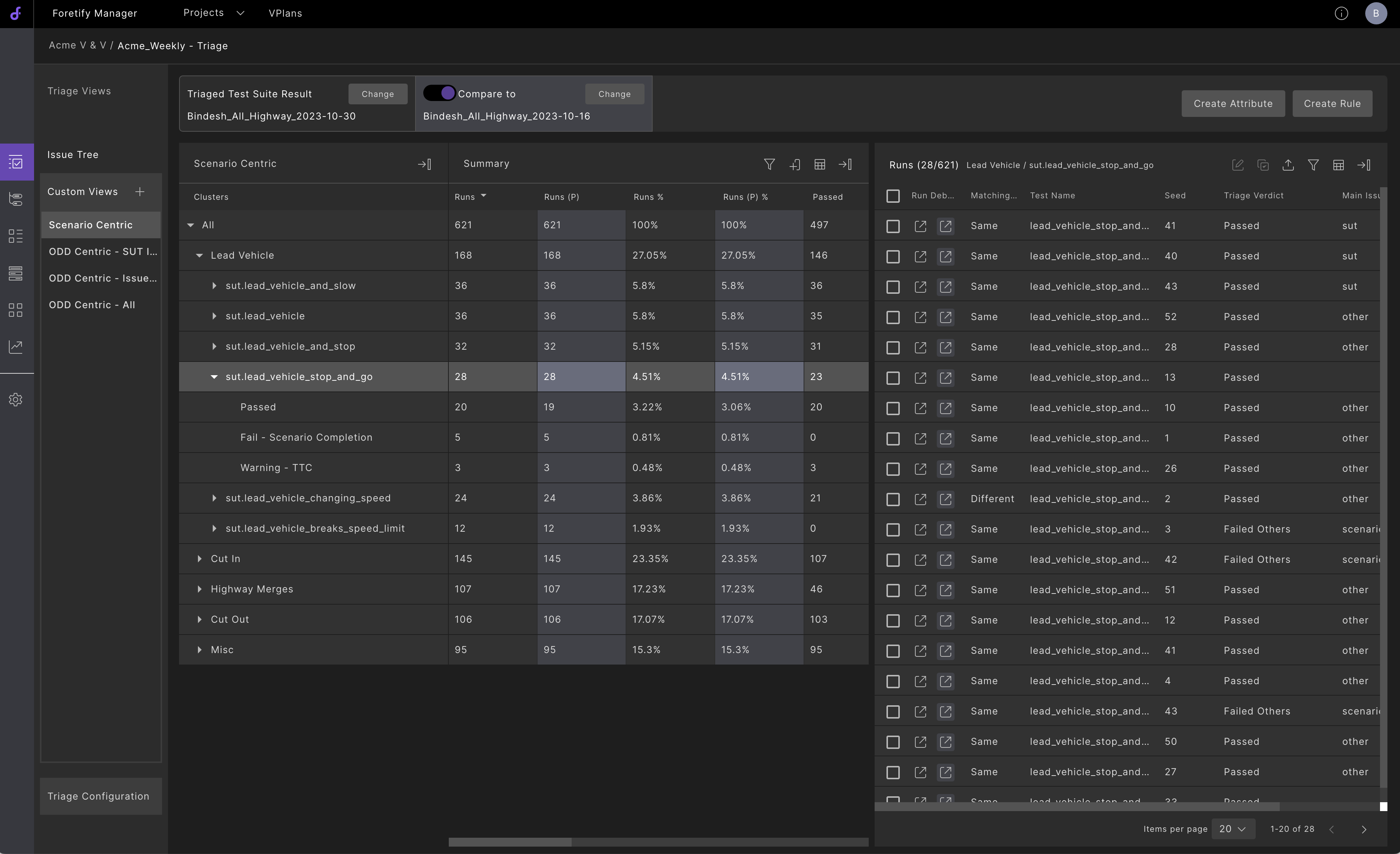
Typically, users upload a test suite run to Foretify Manager for analysis. They’ve always done this to check completeness (coverage analysis) and analyze issues. The team would first use our features, which I mentioned before, to cluster and categorize issues into unique sets of similar problems that need further investigation.

This clustering is automated using pre-defined rules you create in Foretify Manager. It’s important because it saves time. Plus, the triage process is iterative, meaning the status of these clusters is constantly monitored and refined for quicker resolution – that’s the ultimate goal!

Once you have these automated clusters, they can be assigned to specific owners and even linked to other systems like JIRA, a bug tracking tool. After assignment, owners can easily use Foretify Manager’s existing debug features with just one click. This helps them get right to the root cause of the issue and ultimately fix the system under test (SUT).

Here’s another benefit: If a new regression test appears, say tomorrow or next week, Foretify Manager lets you compare it with previous runs using the same rules, clustering, and views. This helps you ensure your overall V&V process is improving over time.
 

How does the triage feature work with Foretify Manager?

We’ve mentioned a few features here and there, but let’s dive deeper into some key ones that make this all possible. One of the big things is the concept of attributes. These can be system attributes, like whether a test run passed or failed according to Foretellix. They basically act like key-value pairs.

Now, with triage, we let you create your own custom attributes. These can be set anywhere, from the runs table to the triage views we’ve discussed. But the main way to set them is through rules. You can define these rules either through the user interface or our Python SDK API.

These rules basically tell the system how to set attributes based on other data. The whole point of attributes and rules is to allow you to group similar test runs together.

Once you have these attributes set and the runs are clustered, you can use the customizable triage views inside Foretify Manager. These are basically hierarchical views of the clusters you’ve created based on all those attribute settings. They’re basically clusters that make sense for you – that’s the essence of clustering and categorization. And from there, you can take action on each cluster, as we discussed earlier.

On top of that, you can also set up user-defined aggregations. These let you easily answer complex questions, like “show me the collision rate in cutting scenarios where the speed was above 90 kilometers per hour.” You can easily set up these “aggregates” to display and analyze this kind of data. We also have powerful built-in filtering capabilities, which let you focus only on the relevant information.

All of this boils down to being able to compare test results from different runs, say from different points in time. This allows you to track the trends you’re interested in.

How does the triage feature boost efficiency and scalability in development?

Traditionally, test suite results are uploaded to Foretify Manager for analyzing coverage and key performance indicators (KPIs). Now, with this new built-in triage component, you can seamlessly perform triage tasks for your V&V projects within the same platform. It’s important to remember that without this, most of this work would be done manually and outside the system, maybe using spreadsheets or custom scripts.

Foretify Manager brings everything together. The key benefit? It eliminates data fragmentation, where information gets scattered and lost.

As we’ve discussed, you can set attributes within triage views. These attributes can define things like owners and even link to other tools like JIRA, a popular ticket tracking system. This way, individual owners can focus on the key issues assigned to them. They’ll see the corresponding JIRA ticket right there in Foretify Manager. With a single click, they can open that ticket directly in JIRA.

How do you recommend training engineers to effectively use the triage feature?

To help you get started, we offer a dedicated training module on failure triage. This covers both the methodology itself and how to use our tool effectively. It’s a great resource!

On top of that, our Applications Engineering Team (AET) has a wealth of experience in advanced V&V. They’re also very familiar with this new failure triage feature. They work closely with our customers to help them adopt both the capabilities and the methodologies around it.

Thank you for joining us today, Bindesh, and explaining the new triage features of Foretify Manager. Please visit the Foretify Manager page for more information.
 

The new solution enables AV training and validation with highfidelity sensor simulation.  

Ensuring the safety and reliability of autonomous vehicles (AVs) while accelerating time to market and controlling development costs is paramount. Addressing these challenges, Foretellix integrated the NVIDIA Omniverse Cloud APIs to enable high-fidelity sensor simulation on the Foretify™ platform. The new solution revolutionizes the way AVs are trained and validated by providing physically based, high-fidelity, end-to-end simulation at scale. The new solution will benefit both emerging AV stacks that rely on end-to-end AI training and stacks that comprise separate perception and planning subsystems. 

This week, NVIDIA and Foretellix are demonstrating the enhanced sensor-simulation workflow at GTC.

“With high-fidelity sensor simulation, the Foretify platform delivers a complete toolchain for training and validating autonomous vehicles,” said Ziv Binyamini, Foretellix CEO and co-founder. “By integrating the NVIDIA Omniverse Cloud APIs, we enable customers to streamline and automate the development process, reduce development costs, and accelerate the deployment of autonomous technologies on a global scale.” 

“The AV industry is expanding the use of end-to-end AI models, which require physically based sensor simulation,” said Zvi Greenstein, Vice President of Autonomous Vehicle Infrastructure at NVIDIA. “By leveraging NVIDIA Omniverse Cloud APIs, Foretellix is enhancing its Foretify toolchain with new sensor simulation capabilities and setting a new standard for AV development and validation.” 

The Need for High-Fidelity Sensor Simulation  

Modern AVs rely on multiple sensors, including video cameras, radars, and lidars, to generate an accurate worldview. The AV must accurately identify, track, and react to many actors, including other vehicles, pedestrians, cyclists, and more. It must also handle real-world aspects such as weather, light and road conditions, and sensor degradation. However, real-world data collection for training and validation is an extensive and costly effort, including test drives, data logging, and labeling.  

While object-level virtual simulation is broadly used to validate the planning and control system, sensor simulation is required to validate the perception system. Furthermore, emerging AV solutions rely on sensor data to train and validate the AI end-to-end.  However, achieving sensor simulation that accurately reflects the behavior and physics of the real world at scale is incredibly challenging. 

Performance and safety issues often result from the interaction between the perception and the planning and control subsystems. When these subsystems are validated separately, some issues can appear only during real-world tests. To ensure the safe operation of the AV, in addition to sub-system validation, the entire system needs to be validated from end to end under a large variability of driving scenarios, perception conditions, and locations. 

Virtual End-to-End V&V 

Foretellix and NVIDIA can deliver physically accurate, virtual, end-to-end validation at scale by enabling high-fidelity sensor simulation via the Omniverse Cloud APIs. The integration provides seamless access to NVIDIA’s breakthrough sensor simulation performance and Foretellix’s state-of-the-art automated test generation and monitoring technology. 

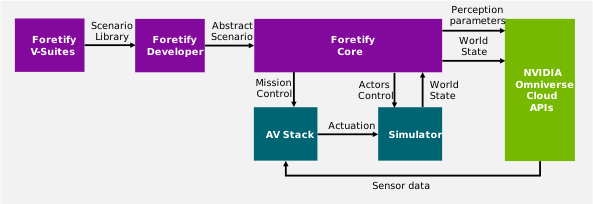
Foretellix customers can leverage abstract scenarios to automate the generation of end-to-end tests, perform large-scale triage, assess performance and KPIs, and measure ODD coverage. Figure 1 below shows a high-level diagram of the test development flow. 

Figure 1 – Virtual V&V development flow

The Foretify Core test generator uses abstract scenarios created by customers using Foretify Developer or ready-made scenarios imported from V‑Suites – the industry’s most comprehensive OpenSCENARIO® 2.0 (DSL) library – to generate and execute concrete tests comprised of multiple actors, including maneuvers and perception parameters. It provides mission control information to the AV stack, actor control commands to the simulator, and world-state and perception parameters to the NVIDIA Omniverse Cloud APIs. 

The Omniverse Cloud APIs render physically accurate sensor data based on the simulated world state and the provided perception parameters. It delivers the sensor data to the AV stack, which processes it and generates actuation commands for the simulator. 

Foretify Core executes the test by controlling the simulator at runtime. It uses advanced behavioral models to dynamically control and adjust each actor’s actions during simulation execution to achieve the scenario intent. Foretify Core is pre-integrated with most industry-leading simulators and can also integrate with OEM proprietary platforms, such as the Nuro simulator, as demonstrated at NVIDIA GTC.  

With these new capabilities, the Foretify Platform can measure ODD coverage across multiple perception parameters to analyze and report which conditions have been tested in various driving scenarios. This significantly improves the ability to assess the system’s safety and testing efficiency. 

High-Fidelity Reconstruction and Smart Replay of Drive Logs 

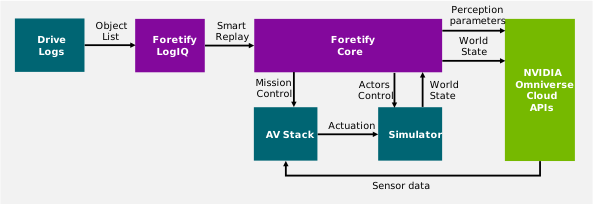
Companies developing AVs collect a huge amount of drive logs through physical drives. Storing all sensor data requires enormous storage space; thus, often, only object-level information is stored. Foretify LogIQ enables object-level drive log ingestion into the high-fidelity virtual simulation flow to reconstruct and replay a physically accurate sensor-level simulation of the drive log (Figure 2). This provides significant time and cost savings in developing, debugging, and issue resolution. In addition, the Foretify Smart Replay capability can generate variations of the original drive log, including perception parameter variations and maneuver modifications, to improve the validation of new AV software versions. 

Figure 2 – Drive Log Replay Flow

Generate Synthetic Data Sets for Training 

Retraining AI systems is often required when the AV underperforms in certain conditions, such as unknown edge cases found during validation in physical driving or virtual simulation. Using Foretellix Foretify and NVIDIA Omniverse Cloud APIs, developers can now automatically generate a large number of sensor-accurate data sets to train the AV. This is especially useful when it is unsafe, costly, or difficult to recreate similar conditions in a test drive. 

Enhance Safety, Improve Time to Market, and Reduce Development Costs 

The Foretify platform with Omniverse Cloud APIs powers a major shift in AV testing, accelerates AI training, enables much higher utilization of drive logs, and improves the synergy between physical drives and virtual testing. It enables OEMs and AV developers to perform end-to-end, physically accurate simulations to help improve AV performance and safety, accelerate time to market, and reduce development costs. 

To learn more about the Foretify platform, visit www.foretellix.com/foretify-toolchain-overview/. To learn more about NVIDIA Omniverse Cloud, visit www.nvidia.com/en-us/omniverse/. 

Ensuring the safety of Autonomous Vehicles (AVs) requires testing millions of scenarios using virtual simulation to cover the nearly infinite number of scenarios that AVs might encounter. The goal is to ensure thorough ODD coverage and uncover edge cases that could be a significant safety risk. Doing this efficiently and economically is a considerable challenge for the AV industry. 

Maintaining our leadership in safety-driven V&V technology, we are thrilled to announce the Foretify 2024 release featuring Foretellix’s newest constrained-random test generation technology. The new test generator represents the culmination of tens of man-years of research and development, leveraging technology proven over decades of verification and validation of highly complex systems. The new Foretify release delivers 10X performance improvement compared to the previous generation. It is the automotive industry’s most efficient test generation, execution, and management solution.  

Foretify utilizes the latest ASAM OpenSCENARIO® 2.0 (DSL) scenario description language to deliver best-in-class V&V automation at scale. Foretify dramatically reduces the tedious, manual effort of creating tests by automating the generation of an unlimited number of concrete, meaningful, and valid test scenarios to cover the ODD optimally. It also stresses edge cases and exposes unknowns to identify safety and performance issues. It has driving domain semantic awareness, which enables it to choose parameter values consistent with each other, all system constraints, and the laws of physics.  

Early customers using the new Foretify release have reported over 10X improvement in the test generation and execution time of complex scenarios. This translates to higher efficiency, more productivity, shorter time to market, faster ODD expansion, and cost savings in developing and validating advanced ADAS and AVs. 

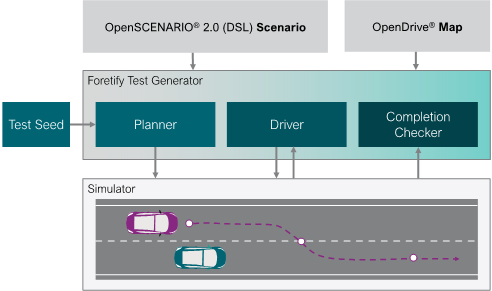
Figure 1 shows a high-level diagram of the Foretify Test Generator. The Test Generator receives an OpenScenario® 2.0 (DSL) scenario and an OpenDRIVE® map as inputs. The Planner automatically chooses a location on the map where the scenario can be executed as intended, and it calculates initial waypoints for each of the scenario actors while considering all global and scenario constraints. Changing the test seed automatically creates a new scenario variant at a different map location with random scenario parameters within the given constraints. The Driver executes the test by controlling the simulator and the AV stack at runtime. It uses advanced behavioral models to dynamically control and adjust each actors actions during simulation execution to achieve the scenario intent. The Completion Checker checks that the scenario intent captured in the OpenSCENARIO 2.0 code is achieved and automatically flags incomplete scenarios. 

Figure 1 – The Foretify Test Generator

Foretify is the leading Safety-Driven V&V platform. The platform is used by engineers at OEMs, Tier-1 suppliers, and AV stack providers to accelerate the development and deployment of safe Automated Driving Systems and ADAS.  

For more information about the Foretify platform, visit www.foretellix.com/foretify-platform.
To request a demo, please get in touch with us at info@foretellix.com. 

The Foretellix V-Suites™ are the most comprehensive V&V packages available today, aggregating extensive industry knowledge gained from working with multiple users, regulation requirements, and from collision databases.

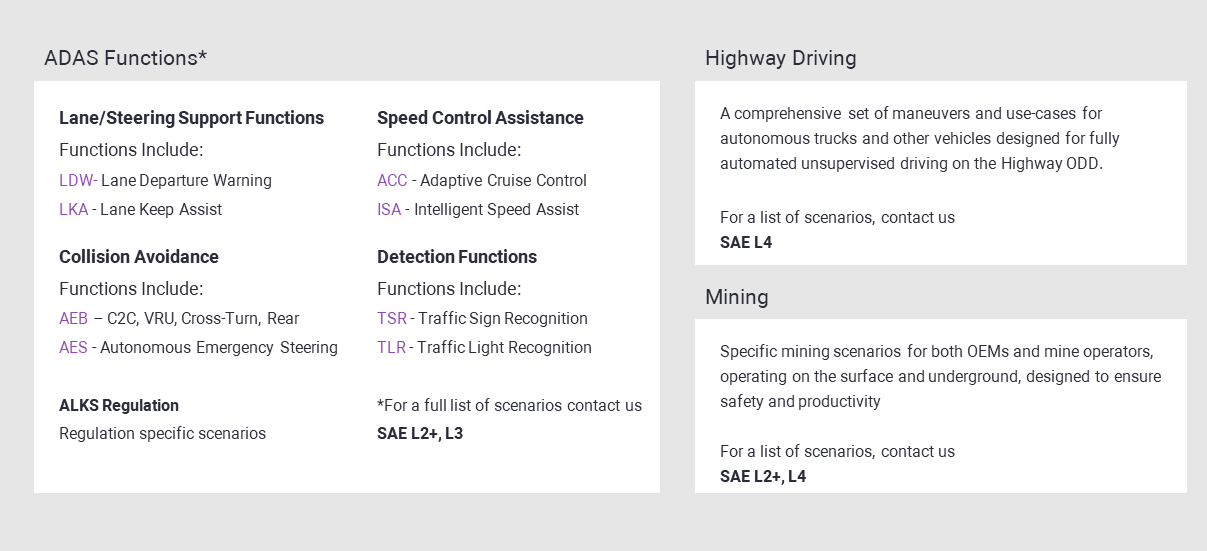
According to users, Foretellix V-Suites™ provide 100x productivity gains compared to scenario libraries using concrete or logical scenarios. The V-Suites™ are implemented in OSC2, which makes the scenarios adjustable to your ODD needs and a great vehicle to ramp up on the much-anticipated standard. Following today’s release announcement, Foretellix is offering V-Suites™ for ADAS functions (L2+, L3), Highway driving (L4), and mining (L2+, L4).

If you wish to understand how such a performance boost is achieved and whether the V-Suites™ can serve your needs, keep reading ?

What are V-Suites™ and what’s new about them?

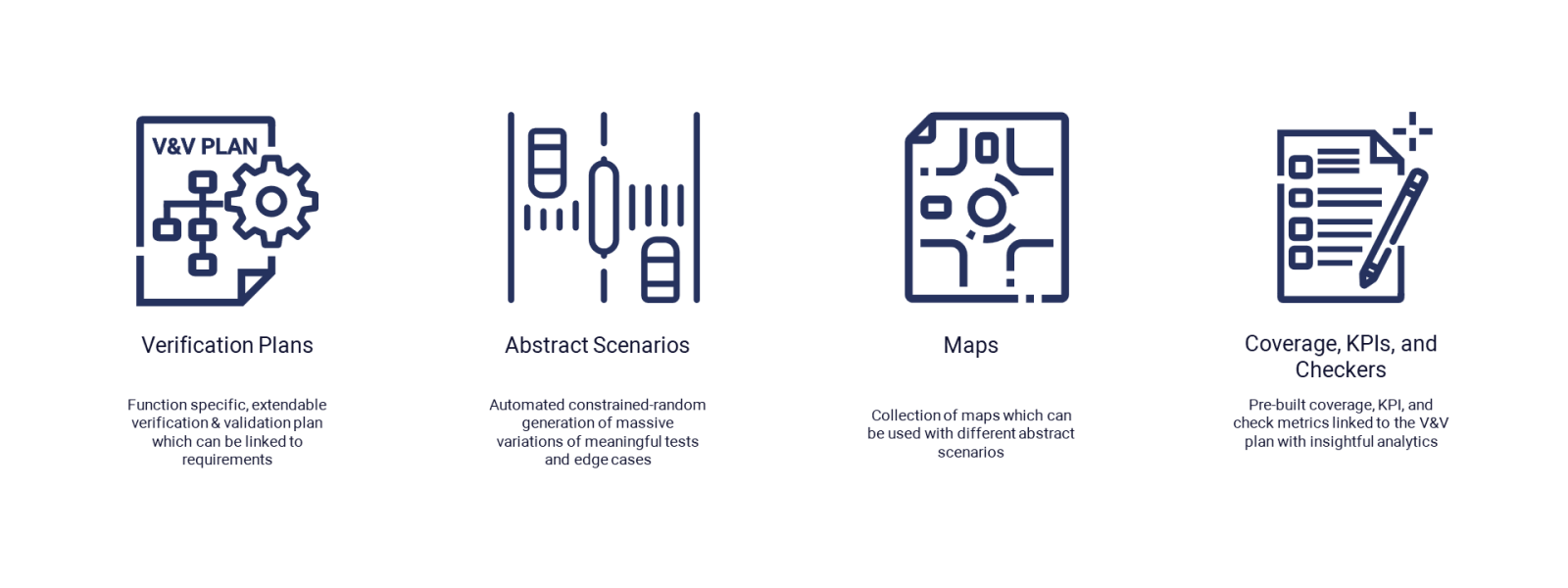
V-Suites™ are Foretellix’s out-of-the-box reusable V&V packages that we have been developing in close collaboration with our customers since 2019. They include abstract scenarios, coverage metrics, reference maps, checkers, and KPIs that report on functional and performance issues with the SUT. You can adjust built-in tests or easily generate new ones with an intuitive user interface that does not require deep knowledge of OSC2. The exciting news is that we have migrated all the V-Suites™ to the standard OSC2 syntax. Additionally, we have enlarged our portfolio, enriched the provided scenarios, expanded the provided HMI support, and enhanced the V-Suites™ to support many L2 – L4 ADAS & autonomous driving functions. This next evolution of the V-Suites™, combined with the native OSC2 engines of Foretify™, provides a fast path for customers to start reaping the benefits of OSC2 in terms of V&V automation and scaling.

Figure 1: V-Suites™ out-of-the-box content

Leveraging the power of OSC2

The ASAM OpenSCENARIO 2.0 Standard is a huge step forward for enabling V&V teams to easily aggregate and share knowledge. It allows defining abstract scenarios that:

  • Auto-adjust to user ODD needs
  • Auto-adjust to any maps and locations
  • Auto-adjust to any test execution platform (e.g. SIL, HIL, proving ground) and its supported capabilities. (For example, when running on the proving ground it is hard to ask for a snow storm.)
  • Auto-adjust to work across different stack versions and vehicle dynamics models, which enables sharing across vendors or projects

On top of the technical considerations, both projects and engineers often prefer acquiring the latest and greatest standard languages and flows. Standards facilitate vendor collaboration and enable technology growth. They may also assist in attracting talented members to your team.

How are V-Suites™ different from typical scenario libraries? 

As the V-Suites™ are implemented with OSC2, I would need to repeat everything that is new and exciting about the language to fully answer this. Nevertheless, here are a few key points to consider when selecting a V&V package:

  1. The scale and quality of the generated scenarios – Assume a package with one-million concrete scenarios in someone’s favorite language. That’s a lot, right? Well, with V-Suites™, it is literally a single line of code to automatically generate an endless number of high-quality scenarios. Since V-Suites™ scenarios are implemented in OSC2, they are not proprietary to a specific simulator.
  2. Projects, ODD, and requirement adjustments – At the recent Automotive Testing Expo in Stuttgart, I came across a manager who inherited a pool of one million concrete scenarios and had the ambitious goal to enable V&V automation for a stack that was targeted to support the Indian market. The first question that came to mind was – “how many of these are driving on India’s roads (including driving on the left)?” The answer was none in this extreme case, but a small subset in many other cases. With V-Suites™ abstract scenarios the predefined scenarios auto-adjust to left-hand-side driving, the traffic laws, and the structure of the roads in India. The steps of adopting any V&V library begin with configuring it to your ODD requirements, maps and road topology, traffic rules, vehicle dynamics, test execution platforms, and more. This is a key benefit of V-Suites™’s abstract scenarios compared to logical or concrete scenarios, where it can be an impractical task to rework the scenarios for specific project needs.
  3. Built-in checkers and KPIs for Scale – What if just one percent of a million scenarios fail? This is 10,000 scenarios to manually analyze, making the question of practicality valid again. V-Suites™ provide many checkers and KPIs specifically targeted at common ADAS functions like AEB, ACC, L4 Highway Pilot, etc… The checkers can automatically flag issues with your SUT at run-time, thus reducing the time and effort of doing root cause analysis. This can save lots of wasted time trying to manually inspect failures when running a large test suite.  The built-in KPIs can be used to easily assess the performance of your SUT.
  4. Ensuring accomplishment of risk conditions and scenarios – Given that the SUT is autonomous and programmed to avoid risk, can I ensure that individual scenarios met their intent? V-Suites™ leverage Foretify’s adaptive scenario execution capability, which automatically tries to ensure a scenario’s intent is met.  This capability can significantly reduce the time and effort required to manually inspect and adjust scenarios so that they meet the intent.
  5. Ability to objectively measure V&V completeness – Establishing V&V completion goals, using them throughout the V&V and development process, and enabling shifting and focusing resources to untested areas is a must for productivity and thoroughness. V-Suites™ are built to support the Foretellix Coverage Driven Verification (CDV) Methodology, which is the gold standard for ensuring you have tested your SUT enough.

What V-Suites™ are available?

Figure 2 shows a subset of the thoroughly implemented V-Suites™. The OSC2 capabilities for rapid scenario development and easy maintenance allow quick high-quality V-Suites™ growth.

Figure 2: V-Suites™ Overview

Note that we constantly expand our portfolio, and several other V-Suite libraries are at different levels of readiness. If you are interested to learn if any of these can assist your project, shoot us an email to get more details.

How can I take advantage of OpenSCENARIO 2.0 V-Suites™?

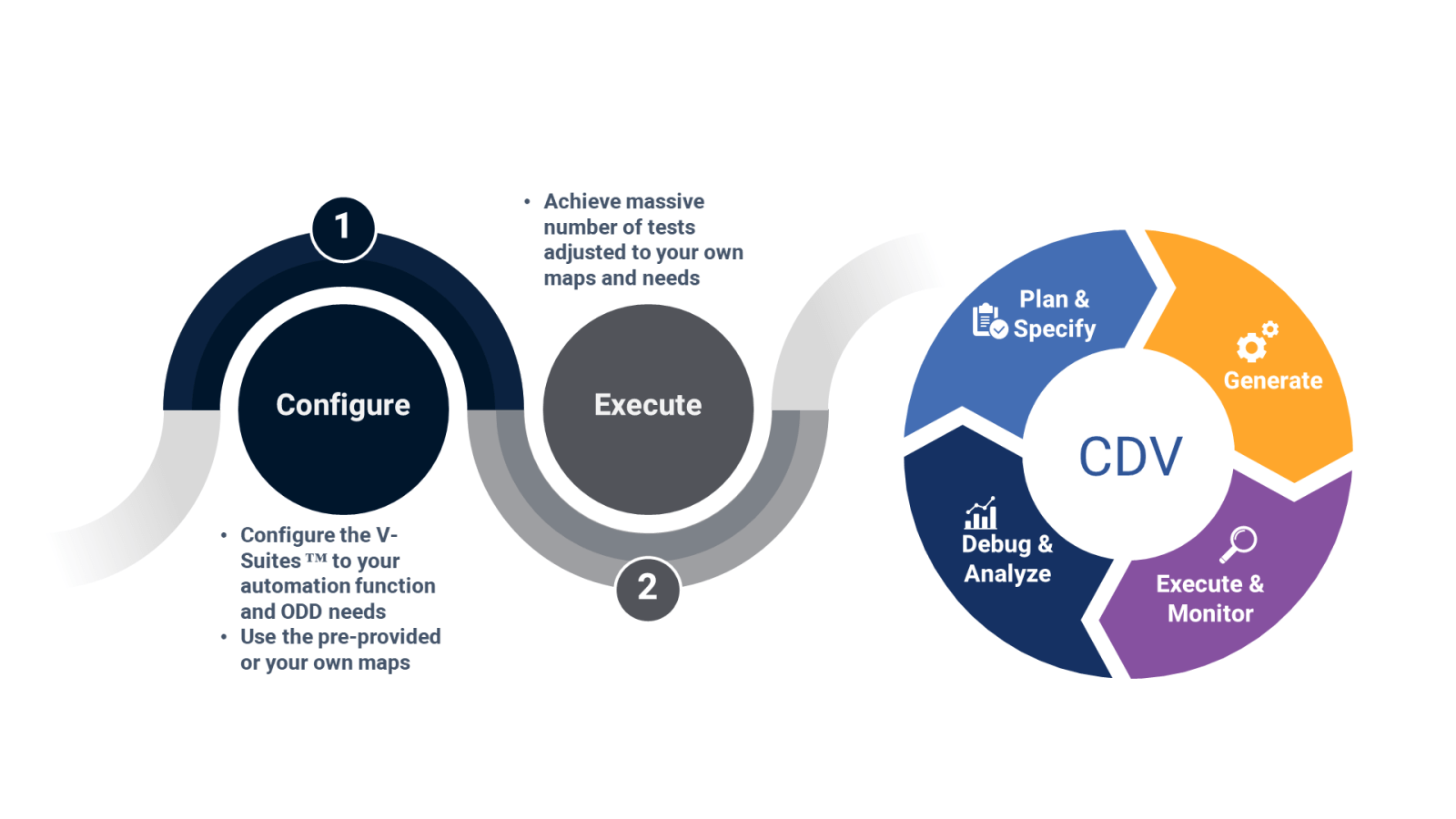
Many customers find the V-Suites™ to be the fastest and easiest way to quickly assess the value of the OSC2. Once the basic Foretify integration with a customer’s SUT is achieved, simple test tables can be used to demonstrate both generic and sophisticated user-defined test suites for generating and running tests at scale.

Figure 3: The fastest path to value with V-Suites™

If you are interested to understand more about our OSC2 V-Suites™ and how they could be leveraged for testing your Autonomous Driving System and ODD, check out our website here or shoot an email to info@foretellix.com.

Drive safe,
Sharon

OpenSCENARIO 2.0 is about to be released with innovative expressiveness and abstraction to fuel revolutionary automation in AV development and V&V processes. We wanted to see if we could use this automation today, to efficiently validate products’ adherence to the recent UNECE level-3 ALKS regulation.

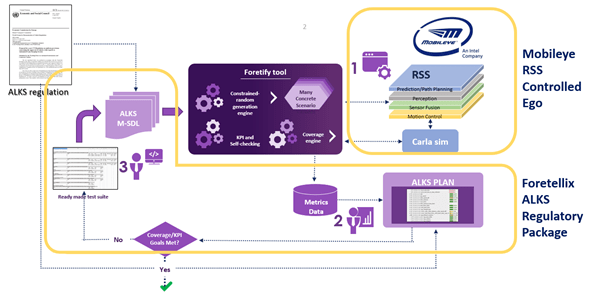
Foretellix announced today its ALKS regulatory solution, and jointly with Mobileye – demonstrated the use of this solution, combined with an RSS controller to verify full system regulation compliance.

Figure 1: a description of the flow

What should you expect from the Foretellix ALKS flow?

  • Efficient scenario creation producing a massive number of tests to accurately capture the ODD’s regulation needs. The scenarios auto-adjust to any desired location or maps, explore the unexpected and unknowns with random intelligent value selections, and are easy to steer to meet user needs using simple spreadsheets.
  • Foretify scenario runtime adjustments monitor the unpredictable autonomous vehicle responses and adjust the other actors’ behavior to meet the user intent. This maximizes the value of each simulation, saves compute and human resources, and shortens the overall verification cycle.
  • Coverage is part of the reporting and a dashboard is presenting what regulation scenarios were actually executed and observed, as opposed to what the test requested. This is especially needed for automation functions like level-3 ALKS where the unpredicted Ego responses may invalidate the test goals.
  • Self-checking scenarios for both the regulatory and RSS rules. The pre-provided checks can be easily refined to meet user needs

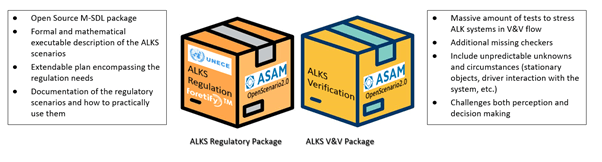
It is important to note that in addition to the ALKS regulation package, Foretellix also provides a more extensive ALKS Verification & Validation package that goes beyond the regulatory needs and validates ALKS devices in multiple prone to error edge cases and unknown conditions such as other maneuvers, various road circumstances, stationary objects (like parked vehicles) and more. A comparison between the two packages is provided below.

Figure 2: The ALKS regulatory vs. the ALKS V&V packages

To learn more about the ALKS regulatory or verification & validation packages please contact us

Register to receive ALKS scenarios verification code examples.

Given the challenges of verifying and validating (V&V) ADAS and automated highway functions, how would you describe the ideal toolset and methodology?

Over the years, Foretellix has collaborated with many ADAS and AV developers to explore their requirements for a ‘dream solution’. In this post, I’ll summarize their answers and offer a solution to the V&V challenges.

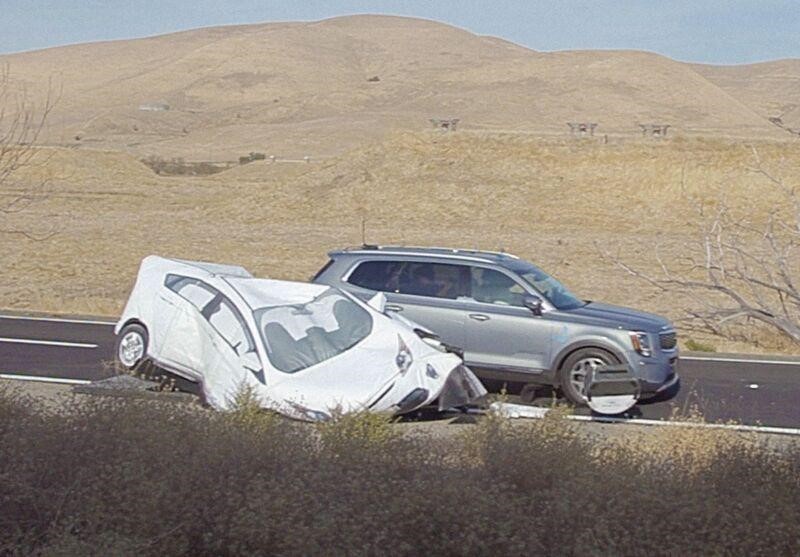
As I’m writing this blog, AAA recommends limiting the use of partially automated driving systems (you can read more here, here and also here). Such safety concerns damage public trust and reduce the perceived value of automation functions. And OEMs are, indeed, devoting large (and growing) efforts to the V&V of these functions.

‘New cars can stay in their lane—but might not stop for parked cars’ (Credit: AAA)

We at Foretellix, always try to improve the robustness of active safety and automated driving systems by evaluating, challenging, and improving existing V&V tools and workflows.

Users describe their ‘dream solution’

Over the past couple of years, we collaborated with multiple customers and partners, asking them to describe their ‘ideal solution’. Below are the most commonly received answers about this tool  – let’s call it ‘Solution-x’.  (BTW, this is quite a list. If you think that you know the requirements, feel free to jump to the Foretellix offered solution)

Produce a massive number of tests effortlessly and out-of-the-box 

  • While ADAS and highway are simpler than say level 4 AV, an infinite number of things can go wrong. Solution-x should generate an unlimited number (as much as I want) of variations of each scenario-based test and uncover edge cases, unknowns (as per ISO 21448 SOTIF) and efficiently find many bugs
  • The result tests should be of high quality and diversified; unique in locations, trajectories, circumstances, and participants that are beyond attribute variations on a hardcoded scenario.
  • My compute is a valuable resource and my engineering resources even more. I want to make sure that the generated scenarios and tests are both feasible and meaningful with minimal redundancy to ensure efficient execution, and to ensure that my team does not spend time debugging invalid scenarios.

Efficiently meet test intent

  • Solution-x should plan the required scenarios upfront, but also adjust the plan in real-time, according to unpredictable decisions of my SW stack.

Provide goals and report completeness

  • With an infinite scenario space, I need a measurable process to know when I have fulfilled my engineering task
  • Solution-x should provide an extensive verification plan combining industry knowledge of ADAS and Highway, past collisions, and standardization requirements
  • The provided plan should be easily extendible to include project-specific goals
  • If an execution fails to meet the test intent, solution-x should report the failure and suggest a different way to achieve the intent
  • Throughout the V&V process, solution-x should clearly indicate the current status, allowing users to focus on unverified areas and eliminate redundant tests

Combine out-of-the-box and user-defined tests

  • Beyond delivering the generic known prone to error ADAS edge cases, solution-x should make it easy for domain experts to leverage their knowledge and create multiple tests with low effort and minimal learning curve.

Be simulator and testing platform agnostic

  • Our company uses multiple simulators for various needs and may change or adopt another simulator in the future. Solution-x should be portable across all simulators and testing platforms we use (e.g. HIL and test-track)

Use a standard language with an industry commitment and roadmap

  • Standards foster a choice of tools and attract talented users searching for career growth.

Support regulation needs and future automation levels

  • For example, the new UNECE SAE level three ALKS regulation that lists specific needs
  • Current investment and methodology should be useful moving forward to higher SAE automation levels

The Foretellix Solution

While the Foretellix technology already solves many of these challenges, the message from users is to also provide an out-of-the-box solution on top of our powerful “do-it-yourself” tool. Working on specific ODD or automation functions they wish to get assistance with, the major questions of what to test? How to test? And when am I done? Considering all the above now is the perfect time to lift the curtain and introduce our solution-x: the Foretellix ADAS and Highway Solution.

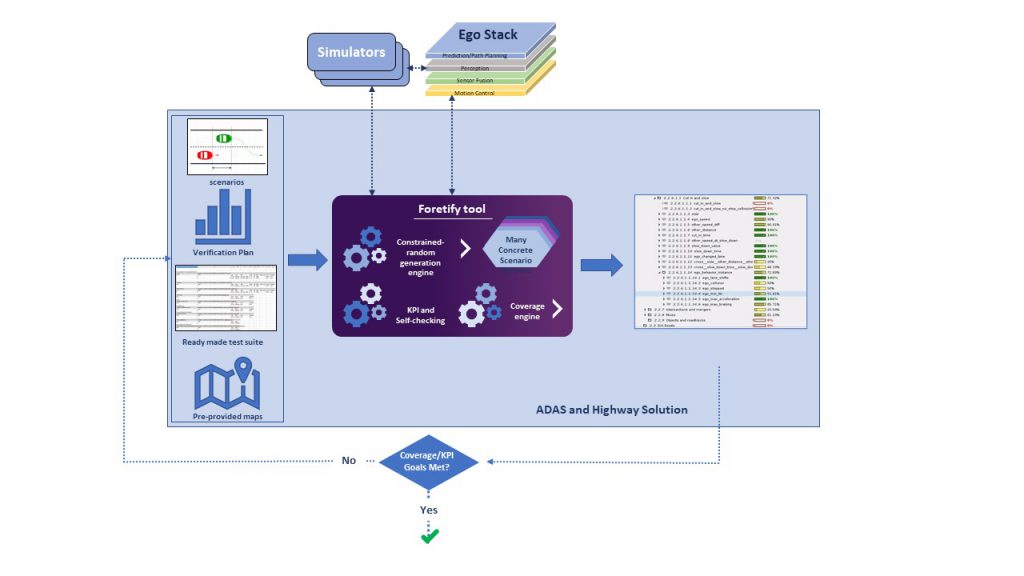
Figure 1: Foretellix out-of-the-box ADAS and Highway solution

The ADAS and Highway solution is the first of a family of verification packages that utilize the power of the Foretify platform and extend our multipurpose platform to address the unique challenges of different functions and ODDs. The ADAS and highway content is based on the conducted research of customers careabouts, past collisions, technology limitations, upcoming regulations, safety standards, and disengagement reports to deliver an effective solution for exposing bugs and promote safety.

Our ADAS and Highway solution was designed for ADAS and Highway V&V tasks, including:

  • A verification plan representing many scenario categories, variants, and overall coverage space that must be completed as part of the V&V process.
  • Extensive ready-made regression that activates and mixes 36 abstract M-SDL maneuver scenarios to generate 100,000s of meaningful concrete tests, stationary objects in random location and angles, and other risk dimensions.
  • Self-checking mechanism with pass-fail criteria
  • An intuitive dashboard displaying the executed and, as important, the non-executed scenarios
  • Simplified spreadsheet-based tabular interface to enhance and refine the tests to hit non-verified concerns and make sure we generate meaningful and feasible scenarios

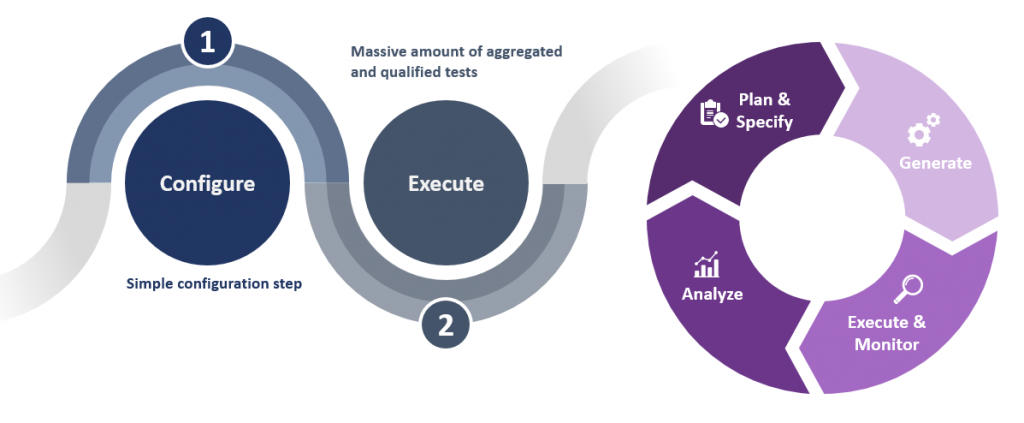
The solution requires a simple initial integration step after which, both expert and naïve users can exercise the solution to achieve a thorough exploration of their devices.

Figure 2: The Shortest Path to Value

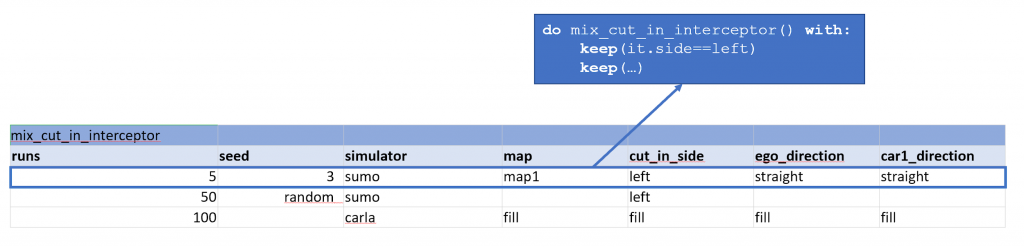
The ADAS and Highway Solution pre-provided test regression is captured in a readable table format, that can be easily extended to meet any user needs. Users fill out a spreadsheet indicating the tests to run while either specifying concrete values for test attributes or asking the solver to complete the missing attributes with random values that adhere to abstract constraint requirements. Each table raw is equivalent to coding an M-SDL test.

Figure 3: Simplification and Productivity with Spreadsheets and a sample of the equivalent generated code

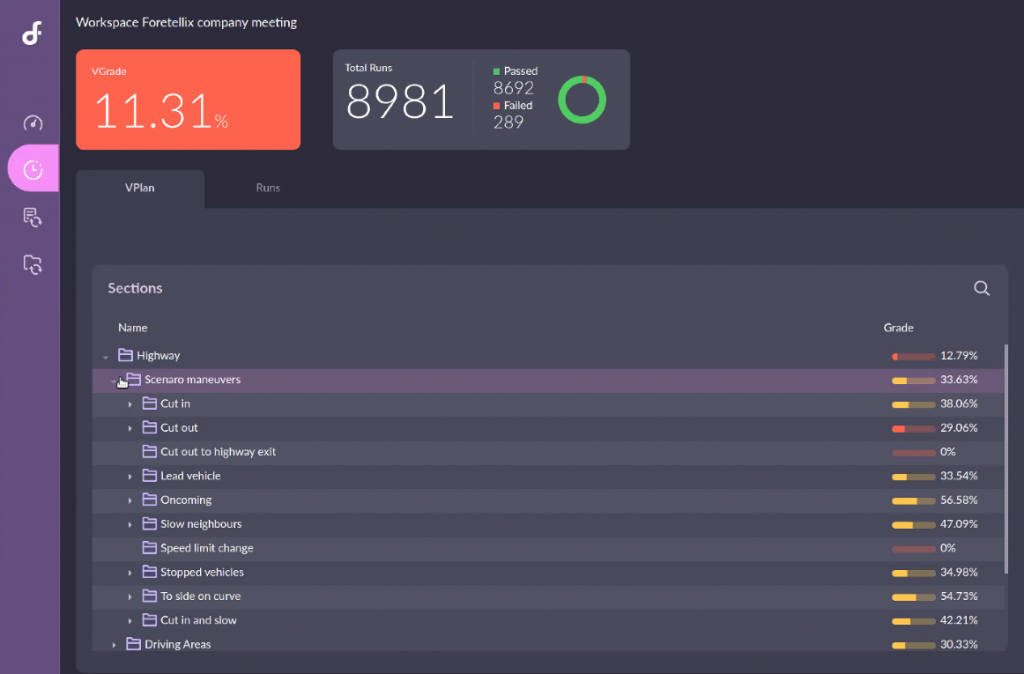
To help users analyze regression results, Foretellix offers Foretify Manager, a highly configurable tool that quickly analyzes DUT errors as well as behaviors of the DUT that have not been well tested.

Figure 4: Foretify Manager

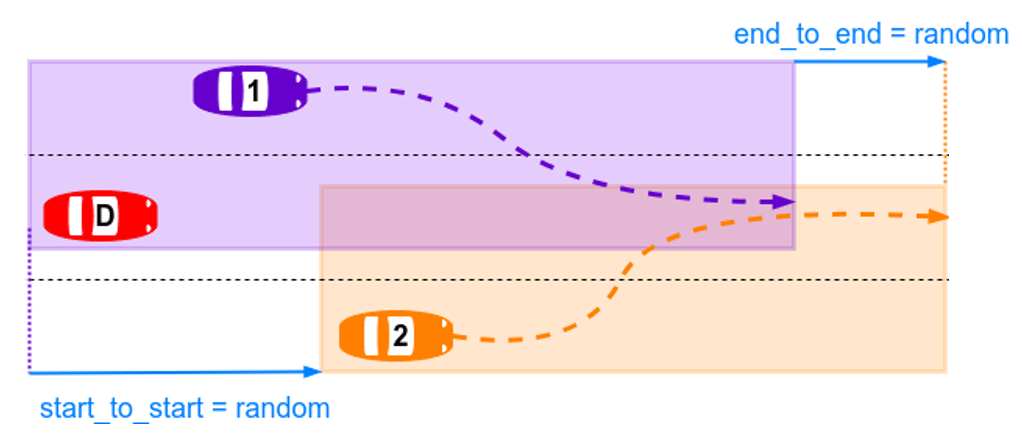
In addition to the pre-provided scenarios, the solution enables a powerful approach to explore unknowns and edge-cases using sub-scenario mixing. The ADAS and Highway solution leverages the Foretify solver to allow users to mix the pre-provided content to achieve new unexpected variations. To better understand the implication of this, please review one of the pre-provided mixes, the double-cut-in mix.

Figure 5: Mixes requires solving power to automate (a double cut-in example)

The purple area above is the first cut-in and the orange one constitutes the second.  The Fortify solver can select a location that matches the two cut-ins needs and inserts implicit actions to ensure the proper vehicle coordination that is needed for the larger double cut-in scenario.

Another key benefit of the ADAS and Highway solution is the use of the open language M-SDL (the basis for OpenSCENARIO2.0 concept project and which is now in the process of becoming a standard). The language enables flexible test customization, extra tuning of the success and failure criteria, and powerful refinements of the built-in coverage model. Adopting and learning the M-SDL triggered interest for multiple individuals and teams that search for the next level of automation.

Note that I did not discuss user regulation needs. This is an exciting part of the ADAS and Highway solution which deserve its own dedicated blog ?

Conclusion

As reported above, the industry still struggles with existing ADAS automation functions, which continue to grow in complexity. The ADAS and Highway Solution offers an extensive out-of-the-box solution tuned for finding bugs and promoting safety.

To learn more about the solution please follow this link, and, as usual, comments are welcome either below or via email 

Travel safely,
Sharon